UX Research · Interaction Design · Prototyping
Overview
Online returns are one of the biggest costs in e-commerce, and one of the most preventable. The challenge Adidas brought to us focused on a specific slice of that problem, optimising adidas.co.uk for UK consumers aged 16 to 22, a group that shops online often, expects a lot from digital experiences, and doesn't stick around when a brand frustrates them.
A team of five designers, each running our own research independently before pooling findings together, set out to understand what was driving returns for this group and what a better product discovery experience could look like.
The project ended with a client presentation at Adidas's Amsterdam office, where we walked their team through our design concepts directly.
Research
Each designer on the team led their own research stream, which we then brought together to build a shared picture of the target user. I ran a desk research review, a questionnaire, a one-to-one interview, and a contextual observation session. Working across methods, and across people, helped us stress-test our assumptions and spot patterns that a single approach would have missed.
Method 01
Reviewed customer feedback on adidas.co.uk, Zalando, and Consumeraffairs.com to surface the most common complaints and patterns around online clothing purchases and returns.
Method 02
Ran a short questionnaire across the target demographic to get a broad, directional read on shopping habits and attitudes toward online returns. Worth treating with some caution, since the respondents skewed toward Norwegian students rather than UK consumers.
Method 03
Interviewed Tea, a 19-year-old Norwegian student living in Sheffield and part of the exact target group. She shops mostly in-store and avoids buying online unless she already knows an item will fit. To her, returns feel like a gamble she'd rather not take.
Method 04
Sat with Sophia as she shopped for a workout outfit on adidas.co.uk, using a think-aloud protocol. Watching her navigate in real time revealed friction points that users wouldn't have put into words if you'd just asked them in an interview.
What we found
Across our combined research, four patterns came through consistently.
Design direction
We mapped the end-to-end Adidas.co.uk shopping experience as a Customer Journey Map, looking at each stage from first visit through to post-purchase. The research pointed clearly to one stage where the experience was most broken, the Consider phase, the moment a user is looking at a product and deciding whether to add it to their bag.
This is where uncertainty about fit and presentation was highest, and where better information design could have the most impact. Here's the core design question we took into ideation.
"How might we present the products at Adidas.co.uk in a clearer way?"

Concepts
We developed three concepts and presented them to the Adidas team at their Amsterdam office. Each concept took a different approach to solving the same underlying problem, helping users build enough confidence about a product to make a good decision at the point of purchase.
Concept 01
Product pages show the same item modelled across different body sizes, with each model's measurements visible alongside. Video try-on elements give users a sense of how items move and fit in real life.
Concept 02 · Chosen direction
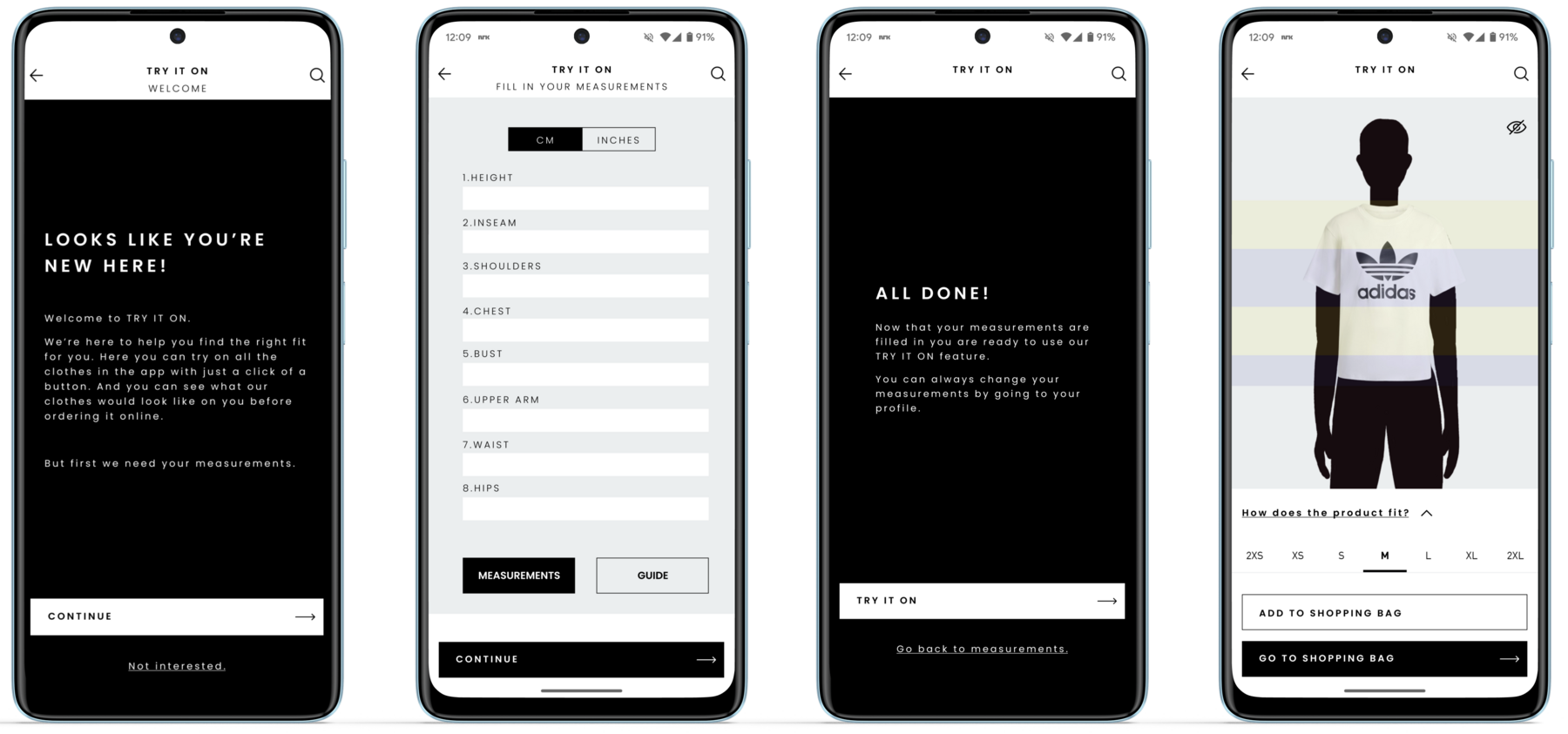
Users enter their measurements. A mannequin updates to reflect their proportions, then shows them exactly how a selected item fits, with a colour-coded fit indicator and a recommended size. It extends into a full fitting room in the shopping bag, where users can try on a full outfit before buying.
Concept 03
A social layer built into the platform, where users create avatars reflecting their body type, browse how other members are styling items, share their own outfits, and read size-specific reviews from people with similar proportions.
The client saw the most potential in the personalised mannequin direction. Concept 1, showing models in multiple sizes, was already on Adidas's internal radar and something their own team was considering. Concept 3 was compelling but raised real concerns around database infrastructure, and felt like it would only serve a narrow segment of highly engaged users.
Concept 2 addressed the core problem most directly. It made sizing personal and visible, right at the moment of decision. It was also technically ambitious enough to feel genuinely new, without requiring a community of users to exist before it worked.
Design & iteration
The first prototype was built within the existing visual framework of the Adidas app. Using a design system already familiar to users meant the new feature could be tested in realistic context, and that the interaction patterns would feel native rather than bolted on.
After an initial round of feedback from lecturers and peers, we made several targeted adjustments before moving into user testing with people from the target group.
User testing
We tested the updated prototype with users from the target group (young adults aged 16 to 22), asking them to complete a realistic shopping task using the new features. The sessions surfaced three friction points that hadn't shown up during internal review.
Final design
The final prototype centred on two connected features that work together to reduce the guesswork in online sizing.
Available on the product detail page. Users enter their measurements (height, weight, and key body dimensions) and a mannequin updates to reflect their proportions. The selected item is shown on that mannequin with a fit indicator. Colours signal whether the fit runs tighter or looser in each area, and the feature recommends a size based on the user's input.
This gives users the confidence to commit to a size without relying on guesswork or ordering multiples to try at home.
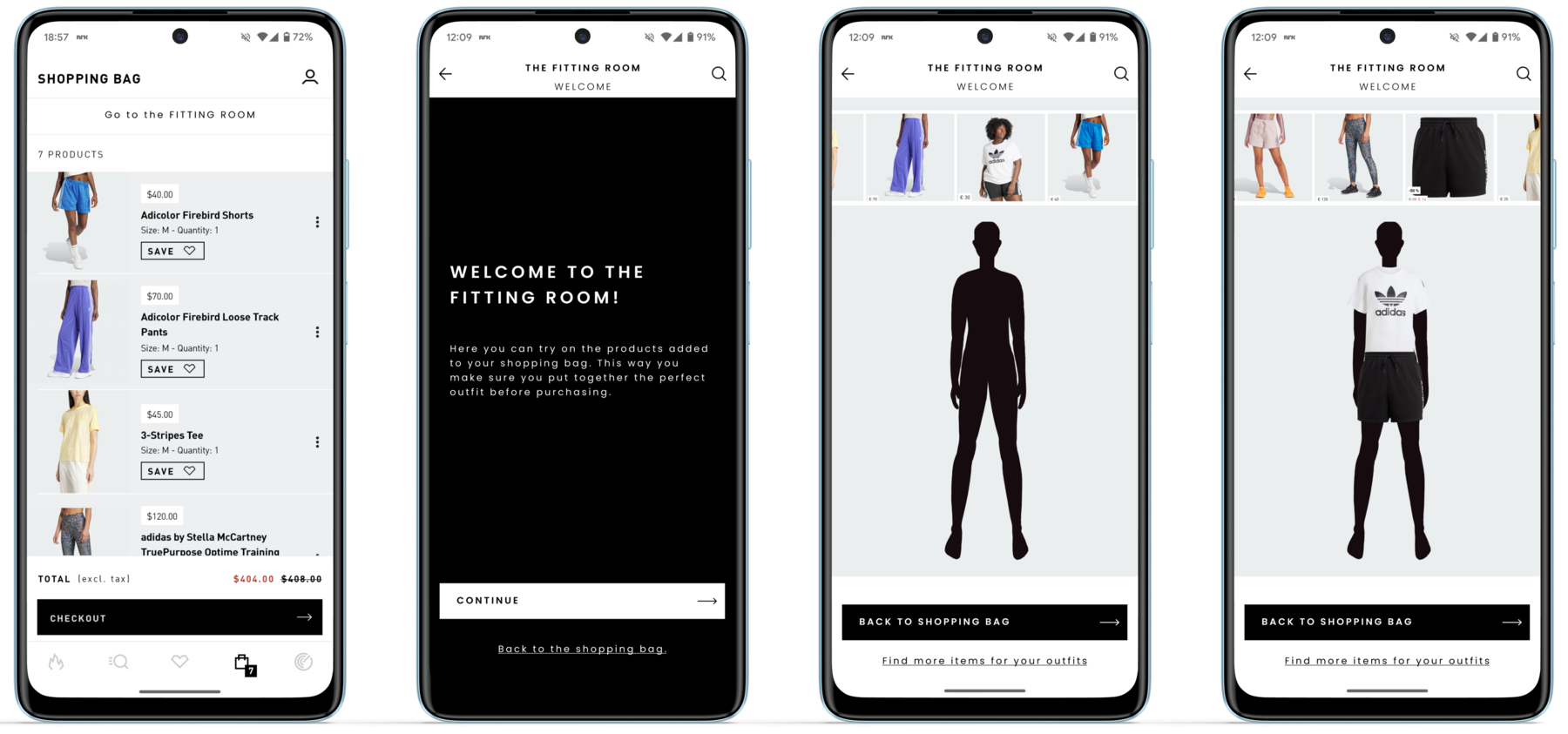
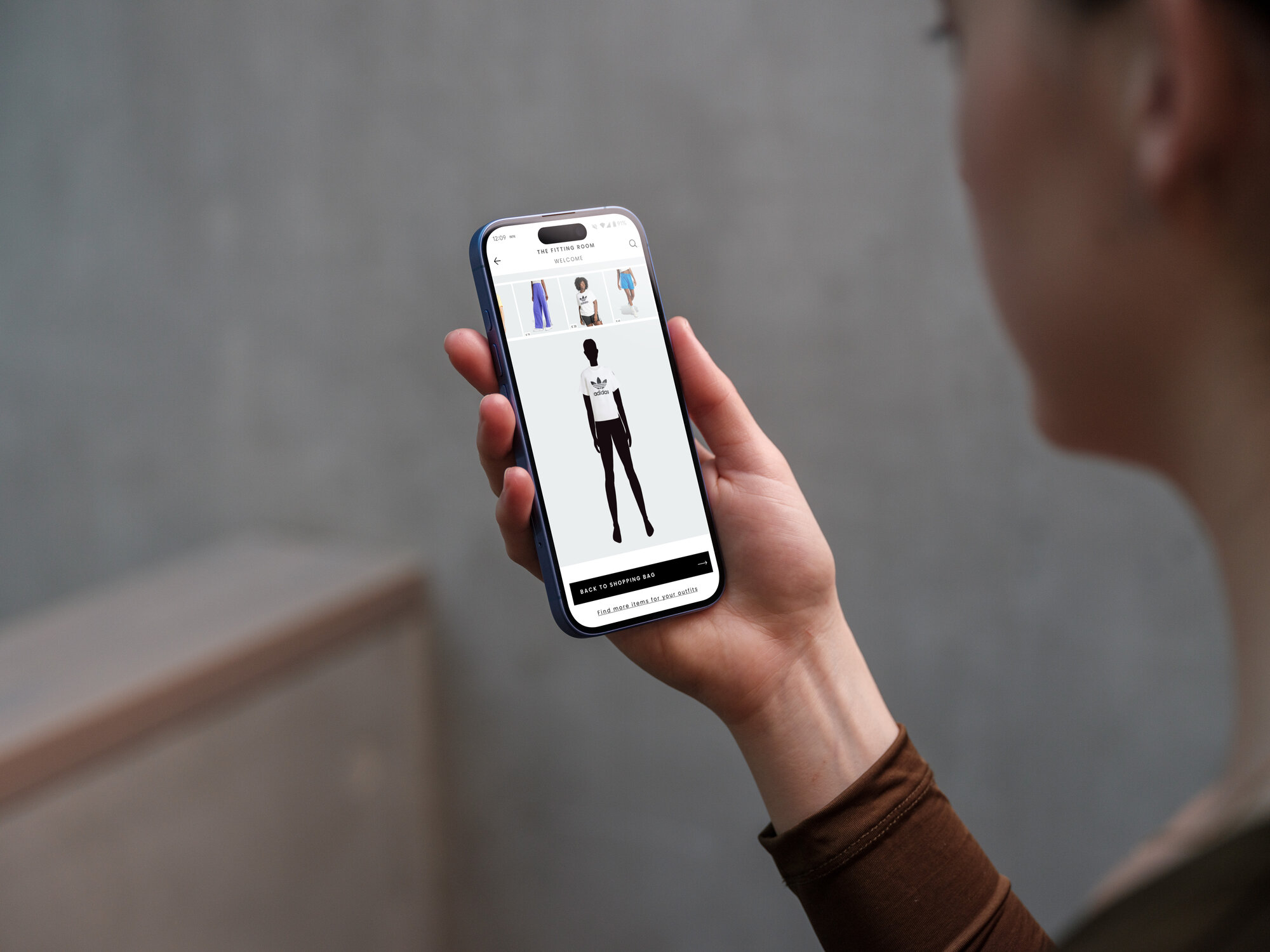
Accessible from the shopping bag. Before completing a purchase, users can enter the Fitting Room to see how their selected items look together as a complete outfit, all on their personalised mannequin.
The Fitting Room moves the decision point from checkout to consideration, giving users a chance to review their cart through the lens of fit and styling before they commit. Items selected in the Fitting Room move directly into the bag, fixing the disconnect we found in testing.
Outcomes
The project produced a tested, iterated prototype that addressed a documented, business-relevant problem in the e-commerce space. The client presentation at the Adidas office in Amsterdam gave the work real stakes. Feedback from their team directly shaped which design direction we pursued.
What I took away from this project wasn't just a prototype, but a sharper understanding of how to use research to make design decisions defensible. Not "we liked this direction" but "users told us this was the friction point, and here's how the design addresses it."
5
Users researched across four qualitative methods (interview, observation, questionnaire, and desk research), each run individually and pooled across the team.
3
Design concepts developed and presented directly to the Adidas team at their Amsterdam office, with one taken forward into prototyping.
2×
Rounds of iteration, one based on expert feedback from lecturers and peers, one based on user testing with the actual target group.
Reflection
The questionnaire we ran produced data that wasn't especially useful, since the respondents didn't match the target demographic closely enough to be reliable. It taught me to be more deliberate about recruitment before running a method. The quality of a study depends more on who takes part than on the method itself.
I'd also push harder on the Fitting Room concept earlier in the process. In hindsight, the disconnect between the "Try it on" feature and the shopping bag was a predictable tension. The two experiences needed to be designed together from the start rather than joined up later.
That said, the core finding held up through testing. Sizing uncertainty is what drives returns, and giving users a personalised, visual way to assess fit addresses it. The direction was right. The execution just needed more iterations to get there.