Overview
The idea for this thesis came out of an internship at frog, part of Capgemini Invent, where I planned and facilitated a co-creative workshop for Avinor, a large Norwegian company, on my own. The client feedback was genuinely positive. A few months later, a peer told me about a workshop of theirs that hadn't landed the same way. That contrast stuck with me. What actually separates a workshop that works from one that doesn't, especially when the people in the room come from completely different backgrounds and disciplines?
Co-creative workshops are one of the best tools designers have for bringing colleagues, clients, and users into the process together, but that only works if the workshop itself is built around how those different people actually think and communicate. My research questions were what categorizes a successful workshop, how different factors can influence a workshop's success, and how we might design workshops that genuinely work for participants who aren't designers themselves.
Research
I interviewed six practicing designers and researchers who regularly plan and run co-creative workshops themselves, from organisations including frog/Capgemini Invent, LEGO, and KTH Royal Institute of Technology. These weren't casual workshop attendees. They were the people responsible for making workshops succeed, and I chose them for variety in gender, age, nationality, and professional background, since I expected those differences to shape how they think about facilitation. Each interview combined two exercises, run over Miro since most interviewees were based in different countries.
Method 01
Interviewees visually built their own ideal workshop in Miro, choosing participants, furniture, tools, snacks, wall colour, even doors and windows. Freed from real-world constraints, they revealed what they'd prioritise if they could control everything.
Method 02
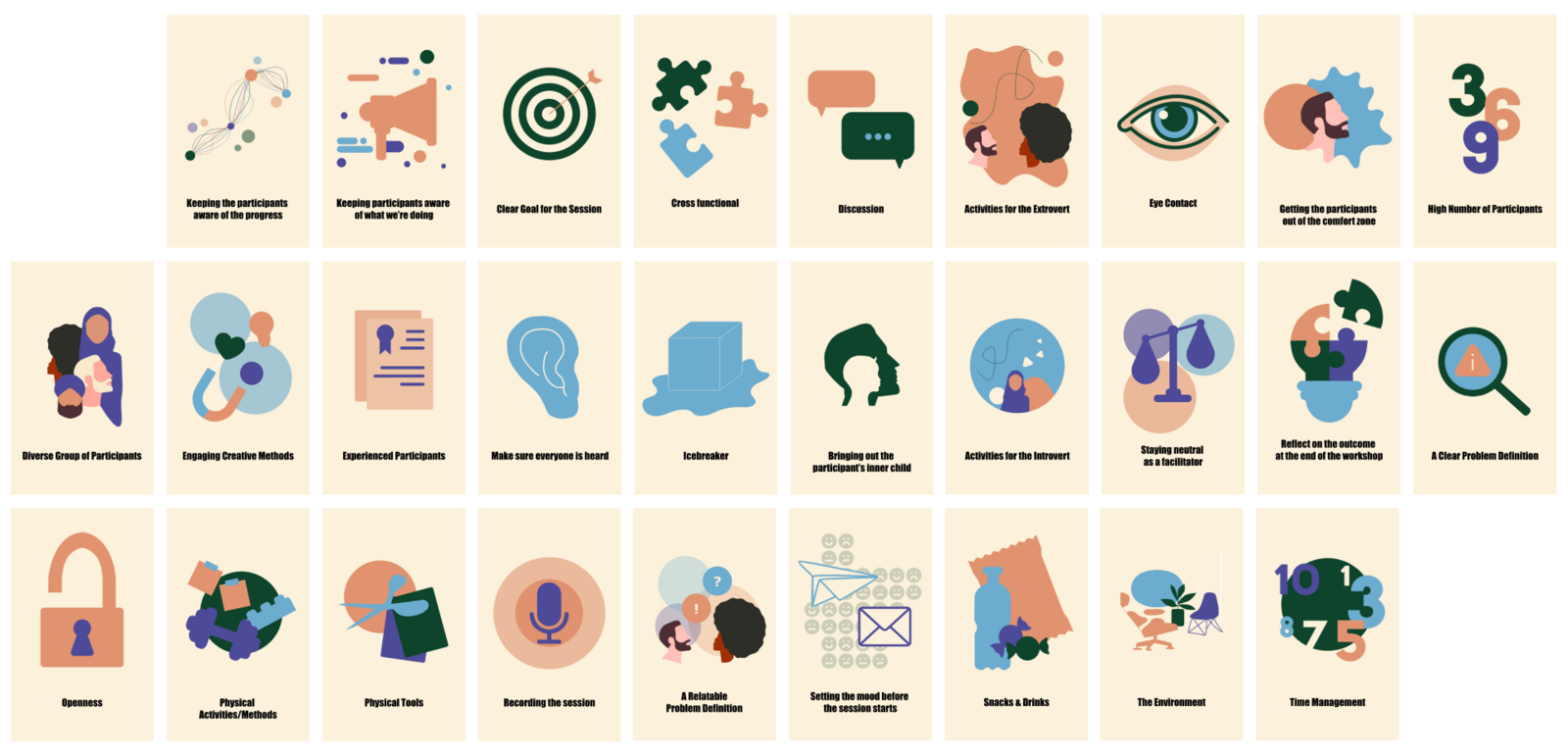
Interviewees ranked a deck of factors (time management, a clear goal, discussion, and more) on a continuum from least to most important, then added their own cards where something felt missing. Later interviews used an updated deck.
What we found
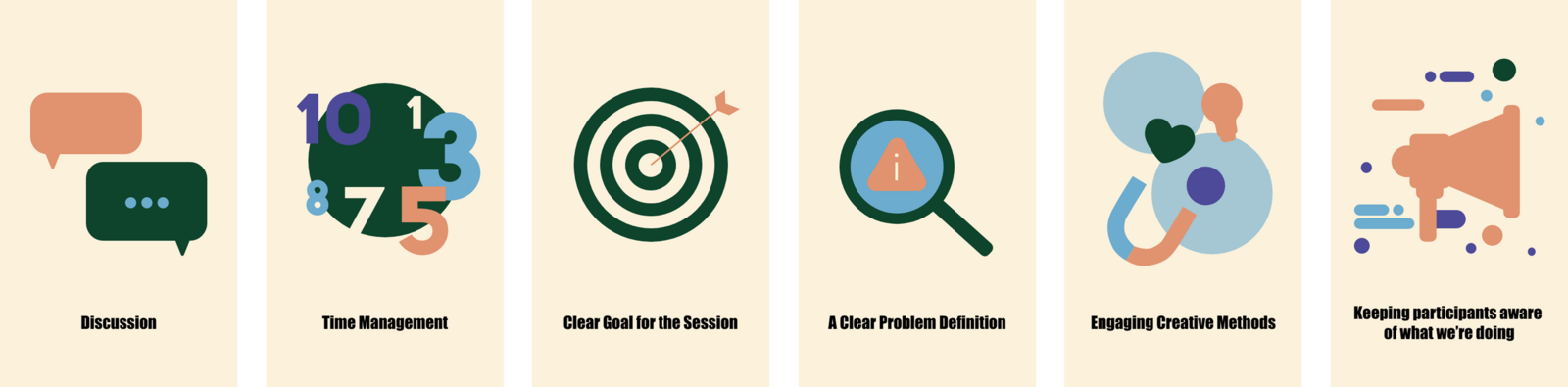
Across the six interviews, a handful of factors kept surfacing as the most important, meaning three or more interviewees independently ranked them highly.
Testing it live
To see whether the interview findings held up in practice, I ran a live experiment at a UX Bonfire session, a recurring knowledge-sharing meeting at frog's Oslo office. Fifteen colleagues roleplayed a workshop about hospital waiting times, split into facilitators, doctors, and nurses, without knowing the real purpose until the end. I deliberately left out a clear introduction, used a room too small for the group, and gave the "facilitators" almost no planning time.
Developing guidelines
I used the KJ method to sort everything the interviews and the workshop had surfaced into five overarching areas, each covering a different part of planning and running a workshop with non-designers.
01
Define a clear goal and problem statement, but stay flexible. What matters most is that participants understand the problem, not that it's narrowly scoped.
02
Cross-functional, diverse groups transfer knowledge and generate better ideas, though experience level matters less than having a mix of perspectives in the room.
03
Use methods within participants' comfort zone rather than pushing them out of it, and structure discussion so quieter participants get equal space to contribute.
04
Aim for calm, uncrowded, and easy to see each other in. Snacks and drinks are an underrated factor in how people concentrate and engage.
05
Neutrality matters, but so does knowing when your role shifts from facilitator to consultant. A second facilitator to manage time and documentation takes real pressure off the person running the room.
Outcomes
The thesis produced a practical framework for planning and running workshops with non-designers, built on what practicing facilitators actually do and what happens when the things they say matter are missing. The live experiment at frog confirmed, sometimes uncomfortably clearly, that the factors interviewees flagged as important weren't just opinions. Leaving them out visibly changed how the workshop went.
6
Expert interviews, each combining a card sorting exercise and a Build Your Workshop exercise, run over Miro.
15
Colleagues at frog's Oslo office who took part in the live roleplay workshop testing what happens when key factors are removed.
5
Guideline chapters developed from the research, covering planning, participants, activities, space, and facilitation.
Reflection
This research only covers the designer's side of the table. I'd have liked to test these guidelines directly with non-designers, rather than relying on designers' accounts of how those interactions tend to go. That would make the findings less one-sided, even though I think what I gathered here is a solid starting point for that follow-up work.
Running the live workshop was more disorienting to facilitate than I expected. Deliberately removing things like time and clarity made it genuinely hard for me to read the room and adjust in the moment, which is its own useful data point about how much a facilitator relies on those factors too.
I'd also like to turn these guidelines into an actual discussion tool designers could use before facilitating non-designers, something that builds shared vocabulary and empathy upfront rather than after a workshop has already gone sideways. Several of my interviewees pointed out that even simple terms get interpreted differently depending on someone's background, which is exactly the kind of gap a tool like that could help close.